

31 - A Writer’s Toolkit: The Writing Tools I Rely On to Draft My Novel
- Renee Ella

- Dec 22, 2025
- 4 min read
Every writer has their things.
The tools, habits, little rituals, that quietly support them through the messy, imperfect, deeply human process of writing a book. Over the years, I’ve tried a lot of systems and apps and routines, and I am very aware that the tools that work best for me might be the worst tools to help you to write. So take this with a grain of salt.
I simply wanted to put all of my favourite writing tools in one place — partly for easy reference, and partly because if even one of these helps another writer feel more supported in their process, it’s worth sharing.
These are the tools that genuinely support my first-draft process and my creative rhythm.
My first draft home
Scrivener is the writing program I use for drafting my novel, and I honestly couldn’t imagine managing a long-form project without it.
I love Scrivener because it lets me hold an entire book in one place without feeling overwhelming. I can break my story down into scenes, rearrange sections easily, keep character notes and worldbuilding tucked alongside the manuscript, and zoom in or out depending on what I need that day.
It supports the way my brain works: linear, big-picture and detail-focused at the same time. When I’m drafting, I don’t want to be thinking about formatting or file management. I just want a space that holds scenes in segmentation so writing doesn’t feel overwhelming. Scrivener does exactly that.
The backbone of my first draft
My first draft is what it is because of The Writer’s Studio Australia. Full stop.
This course mapped my novel from start to finish and helped me turn a vague, emotionally driven concept into a layered, compelling story with structure, tension, and depth. It didn’t just help me finish a draft, it made the draft a thousand times more interesting than my original idea.
What I value most is how the course balances craft with creativity. I never felt boxed in or forced into someone else’s version of storytelling. Instead, I was guided to deepen my story in ways that actually mattered. Using proven story structure.
If you’re someone who has ideas but struggles to shape them into a full novel, this course is genuinely transformative.
Accountability, energy, and shared momentum
One of the most unexpectedly powerful tools in my writing life has been community.
I’m so grateful for the writing community I’ve built on Instagram, and especially for the beautiful writers who show up every two weeks to sprint together. Writing can be isolating, but sprinting alongside others, even virtually, changes everything.
We discovered very recently that 20 minutes on, 5 minutes off is the sweet spot. It keeps the momentum high without burning out your brain. Knowing other people are writing at the same time creates this quiet, collective focus that’s honestly game changing.
These sprints remind me that writing doesn’t have to be lonely to be serious.
My Emotional Support Water Bottle
Non-negotiable
This one might sound simple, but it matters.
I must have my water bottle nearby at all times. Hydration is everything to me, especially during longer writing sessions.
It’s a small thing, but it’s part of how I take care of myself while I write and that care shows up on the page.
Focus, enforced
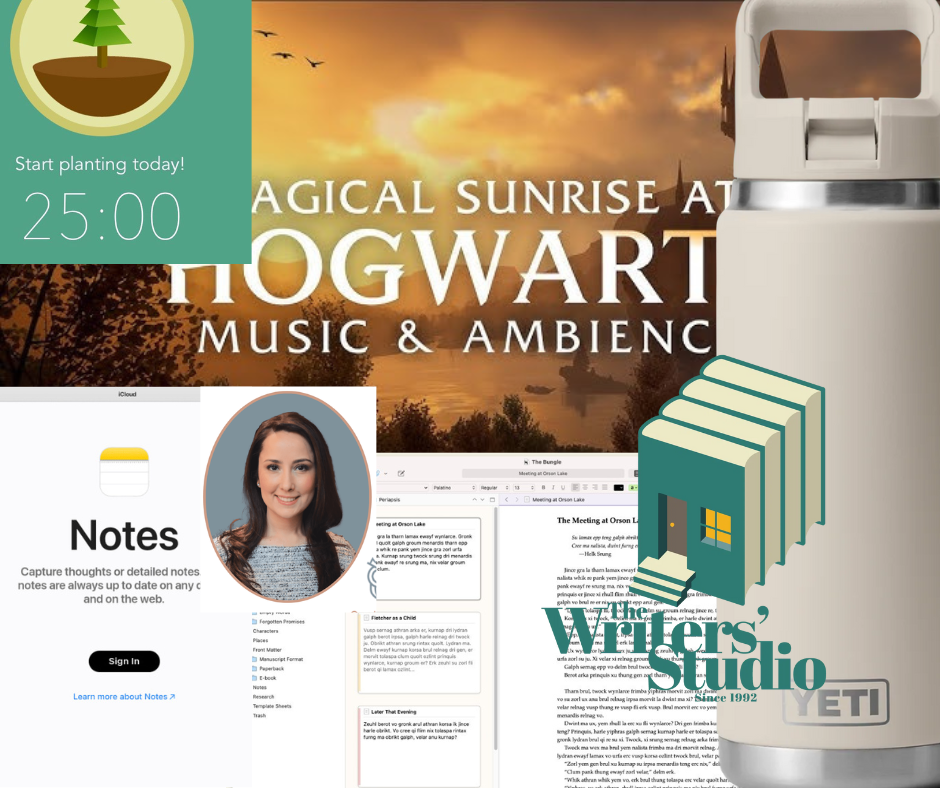
The Forest app blocks my social media and removes the option to “just check quickly.” I plant a tree, set the timer, and write.
I love this app because it removes the need for willpower. I don’t have to negotiate with myself or feel guilty about distractions because the decision has already been made.
Writing time is writing time.
If you struggle with phone distraction (hi, same), this is one of the simplest ways to protect your focus.
iNotes
Where ideas are born
iNotes is where all of my ideas start.
Scene snippets, character thoughts, lines of dialogue, vague emotional beats… everything goes into iNotes first. It’s low-pressure and always accessible, which means I actually use it.
Later, those notes get transferred into Scrivener, but iNotes is the place where ideas are allowed to exist without judgment or structure. And that freedom is essential.
YouTube Ad-Free Long Ambience Audios
Setting the mood
I write almost exclusively with long-form ambience audios playing in the background. No lyrics, no ads, just atmosphere.
These audios help me drop into the emotional tone of the scene I’m writing and stay there. They don’t distract me. They support the work by creating a consistent sensory backdrop that keeps my brain anchored in the story world.
A recent but powerful addition
This is a newer addition to my toolkit, but it made an immediate impact.
After completing just the first call of CeCe Lyra’s Writing Tension course (one of four), I knew these courses were going to be game changers for me. They’re incredibly informative, but more importantly, they’re actionable. I left that first session knowing exactly what to look for in my own work and how to apply it on the page.
For writers who want to deepen their craft without losing their voice, her courses are exceptional.
Epilogue
There’s no single “right” set of writing tools. What matters is finding the ones that support you — your brain, your energy, your season of life.
These are mine. They help me stay focused, inspired, accountable, and grounded as I work toward finishing this book I’ve dreamed about for years.
If you’re building your own toolkit, start small. Choose tools that remove friction, not add pressure. The goal isn’t perfection, it’s progress.
And showing up to write, again and again.
Happy writing,
Renee Ella xx
✨ Want more posts like this? Subscribe to my newsletter below so you never miss a new blog, reflection, or dose of writing magic.


Comments