

8: From Hobbit Holes to Heroes - A Writer’s Guide to the Hero’s Journey
- Renee Ella

- Jul 14, 2025
- 7 min read
Updated: Aug 3, 2025
You know the story…
A protagonist stuck in a dull, lifeless routine. Maybe even a little lost in the dark.
Then one day, they’re pulled into an epic adventure.
They meet a powerful mentor.
They face impossible odds.
They’re forced to overcome the worst parts of themselves and defeat a great evil.
And eventually, they return home… changed forever.
Sound familiar?

The Hobbit, The Lion King, and Star Wars all follow this classic arc.
Each one is shaped by a powerful storytelling structure developed by U.S. philosopher Joseph Campbell.
Originally coined the Monomyth, it was later adapted by screenwriter and producer Christopher Vogler, and is now widely known as The Hero’s Journey.
So why is this structure so effective?
Because it mirrors something deeply human: the desire to grow, to transform, and create a life of fulfillment.
It’s a roadmap not just for epic quests, but for real emotional journeys.
And at its heart is a compelling character arc: the thing that keeps readers hooked.
BREAKING DOWN THE HERO’S JOURNEY
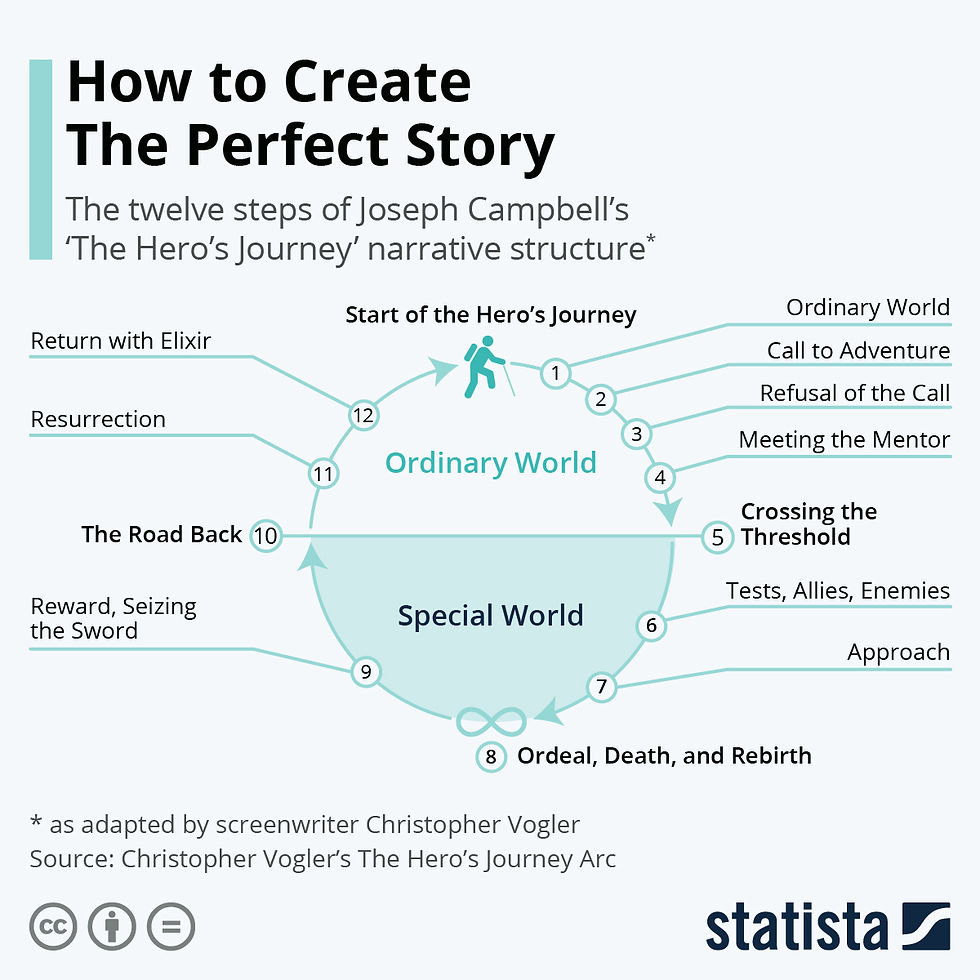
ACT ONE: DEPARTURE
(Occurs in the Ordinary World — 0% to 25% of story)
Ordinary World
Every Hero’s Journey begins with the familiar. We meet the hero in their “normal” world before the chaos begins. We learn who they are, what they value, and what moral flaws or limiting beliefs are holding them back.
They’re ordinary. Just like us.
But something’s broken in their world. Whether they know it or not, they want more. Something is missing. Something needs to change.
Call to Adventure
Also known as the inciting incident. The Hero is confronted with a problem, challenge, or opportunity they can’t ignore. Something that pulls them out of their comfort zone and onto a path of no return.
Make it big. Make it bold. This moment sets the whole story in motion.
Refusal of the Call
Cue fear, doubt, and hesitation. The Hero doesn’t feel ready or doesn’t want to face what’s ahead. They resist.
But the stakes rise again. A new revelation or threat forces them to reconsider. They don’t have a choice anymore.
The refusal makes them human. The second call makes them brave. They have every reason to refuse and one undeniable reason to accept.
Meeting the Mentor
The Hero says yes to the journey… but they’re not ready yet. That’s where the mentor comes in.
The Mentor guides the Hero, offering wisdom, tools, and a challenge to their inner limitations. They help the Hero build the emotional and physical strength needed for the road ahead.
This stage is about preparing for transformation.
Crossing the First Threshold
Around 25% into the story, the Hero commits fully. They leave the Ordinary World behind and step into the unknown.
This is the first major turning point. Something happens that pushes them fully into the Special World (usually triggered by the antagonist).
By now, your central conflict should be clear. If it’s not, this is your sign to raise the stakes.
ACT TWO: INITIATION
(Occurs in the Special World — 25% to 75% of story)
Tests, Allies, and Enemies
Now in the Special World, everything feels different. There’s a shift in tone, tension, and terrain.
The Hero faces a series of trials that build strength, courage, and resilience.They form alliances (not all of them easy).They meet enemies (who push them to the brink).And they slowly begin to evolve.
Allies may share the same goal but not the same values or methods. This creates tension. Enemies, meanwhile, keep upping the stakes and throwing obstacles in the way.
Approach to the Innermost Cave
The Hero is close to their goal but everything’s on the line.
This is the calm before the storm. The group reflects, regroups, and braces for the most dangerous part of the journey.
The Hero wrestles with fear and doubts again because the closer they get, the more they realise what’s truly at risk.
This is also a moment of emotional deepening. Think: tired, bruised, but not broken.
The Ordeal
The Hero’s biggest test yet. The one that breaks them.
The Ordeal often looks like defeat. It’s gritty, painful, and full of emotional weight. The Hero may lose something here or someone. It should feel like rock bottom.
But this is where real transformation happens. Campbell called it the death of the old self and the birth of the Hero.
What they learn in this moment is what will carry them through to the end.
The Reward
The Hero succeeds and gains what they’ve been working for. This could be a physical object, powerful knowledge, or a personal breakthrough.
Whatever the reward, it marks a major victory. This is a moment to breathe, reflect, and maybe even celebrate… before the final descent begins.
ACT THREE: RETURN
(Return to the Ordinary World — 75% to 100% of story)
The Road Back
Just when things feel resolved, consequences show up.
This moment reveals that success isn’t free. The Hero’s actions have triggered something.
The danger returns. Sometimes stronger than before.
Now, they must make a final choice: rise again, or fall apart.
Resurrection
This is the true climax: the final, all-or-nothing, confrontation between Hero and antagonist. The final test.
Everything is at stake. The world, their loved ones, their own soul. It is life or death.
The Hero emerges victorious, but not unchanged. They’ve faced their darkest fear and survived. The transformation is complete.
Return with the Elixir
The Hero returns home wiser, stronger, and no longer the person who once refused the call.
The “elixir” may be literal (a treasure, an answer, a cure), or symbolic: peace, purpose, growth, or redemption.
Their world is different now… because they are different. The circle is complete.
FINAL NOTE
The Hero’s Journey isn’t just for fantasy or adventure. You can apply this structure to romance, drama, sci-fi. Anything, really.
At its core, this framework is about transformation. And every compelling story, no matter the genre, contains that.
APPLYING THE HERO'S JOURNEY TO J.R.R TOLKIEN'S ‘THE HOBBIT'
Ordinary World – Bilbo Baggins lives a quiet, predictable life in the Shire: a place where nothing unexpected ever happens, and where comfort, routine, and social respectability are highly valued. Hobbits don’t do adventures, and Bilbo is perfectly content with that.
Call to Adventure – Gandalf arrives on Bilbo’s doorstep, inviting him to join a group of dwarves on a dangerous quest to reclaim their homeland and treasure from the dragon Smaug. This call completely disrupts Bilbo’s safe and ordered world.
Refusal of the Call – Bilbo firmly declines Gandalf’s offer. Because, once again, Hobbits don’t do adventures. He’s convinced that sort of behaviour is utterly reckless and definitely not suited to a hobbit.
Meet the Mentor – Gandalf becomes the guiding figure in Bilbo’s journey, gently (and sometimes not-so-gently) nudging him out of his comfort zone. Gandalf believes in Bilbo's hidden potential long before Bilbo does himself, offering wisdom, reassurance, and the occasional push when Bilbo needs it most.
Cross the First Threshold – Bilbo wakes to find the dwarves gone and initially he is perfectly grateful for the absence of their disturbance in his comfortable and predictable life. Until their absence stirs something within him. He runs out the door, leaving his familiar life behind. This is the moment he steps across the threshold into the unknown, officially beginning his adventure.
Tests, Allies, and Enemies – Along the journey, Bilbo faces numerous trials: trolls, goblins, giant spiders, Gollum, wood-elves, and more. Each challenge tests his courage and cleverness. He forms strong bonds with the dwarves, especially Thorin though it's a complex relationship, and begins to discover his own resilience and value within the group.
Approach to the Innermost Cave – The group reaches the Lonely Mountain. Bilbo is filled with doubt and fear. Expected to face a literal dragon, he feels deeply unqualified. The pressure of being “the burglar” weighs heavily, and he must confront his lingering sense of smallness.
The Ordeal – Bilbo enters Smaug’s lair alone and steals a piece of treasure. He later engages in a clever though dangerous conversation with the dragon, awakening its wrath. This is a pivotal moment of courage. Smaug, enraged, flies off to attack Lake-town, a consequence of Bilbo’s actions.
The Reward – With Smaug defeated by Bard of Lake-town, the dwarves reclaim Erebor and their treasure. Bilbo has survived the ordeal, but the true "reward" is not gold: it's Bilbo’s growth, wisdom, and moral clarity in contrast to Thorin’s growing obsession with wealth.
The Road Back – Tensions rise as men and elves arrive to claim a share of the treasure for Smaug’s destruction. Thorin refuses. In a quiet act of bravery, Bilbo secretly gives the Arkenstone—Thorin’s most prized heirloom—to the opposing side in hopes of brokering peace. His wisdom and selflessness stand in contrast to Thorin’s growing greed.
Resurrection – The Battle of the Five Armies begins when goblins and wargs attack. Though Bilbo doesn’t play a large role in the fight, his earlier actions help unite the forces that ultimately prevail. This is the final test of Bilbo’s transformation: from timid hobbit to wise, self-assured adventurer. He faints during the battle, symbolic of his internal shift being more important than physical heroism.
Return with the Elixir – Bilbo returns to the Shire, changed forever. Though he brings back treasure, the true "elixir" is his growth in courage, wisdom, and identity. He no longer fits in with the simple-minded life of Hobbiton. He’s seen the world, helped restore a kingdom, and discovered strength he never knew he had.
SO, WHAT DOES THIS MEAN FOR YOU AS THE WRITER?
Whether you're crafting an epic fantasy, a slow-burn romance, or something entirely your own, the Hero’s Journey gives you a powerful framework to guide your story and your protagonist’s transformation.
It’s not about ticking boxes or forcing your characters into a formula. It’s about understanding the emotional rhythm of change, growth, and return.
Because at the end of the day, great stories aren’t just about what happens. They’re about who your character becomes along the way.
Happy Writing,
Renee Ella
If you loved the juicy tips and actionable steps from this post, be sure to subscribe below to be the first to know when the next one drops!

Research:


Comments